
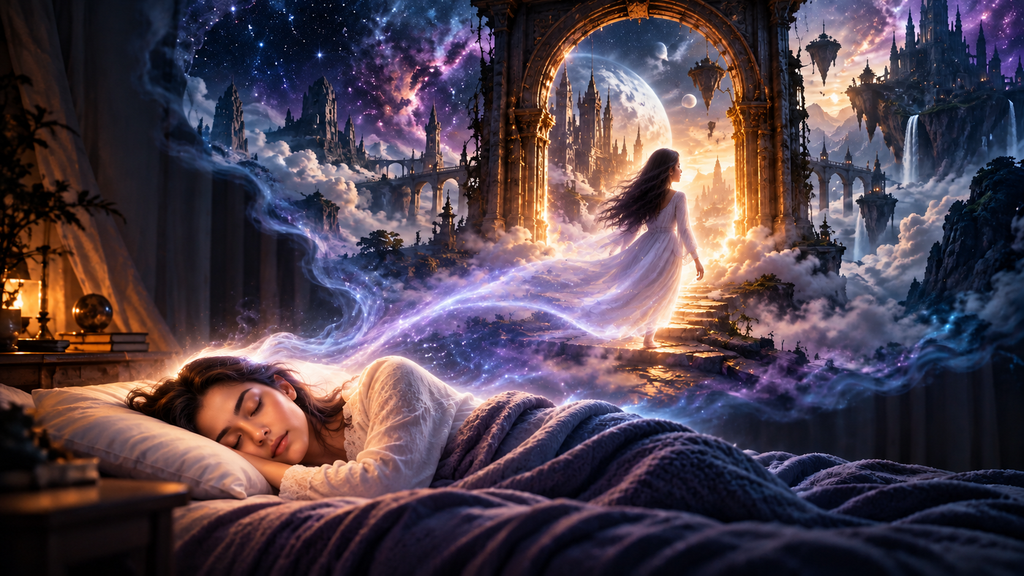
Maya had been dreaming about the same house for seven years.
She had never seen it in waking life.
Yet she knew exactly where everything was.
At the end of a narrow stone road stood a tall, dark house surrounded by enormous trees. Three steps led to a heavy wooden door. Inside was a long hallway, a staircase to the right, and an old mirror hanging beside a window.
Maya knew that if she climbed the stairs and turned left, she would find four bedrooms.
She knew the third bedroom had a blue door.
And she knew she was never supposed to open it.
She didn’t know how she knew.
She simply did.
The Dream That Kept Returning
The first time Maya dreamed of the house, she was sixteen.
At first, there was nothing particularly frightening about it.
She walked through the rooms. She looked through drawers. She touched books covered in dust. She watched rain fall against the windows.
Then she woke up.
Years passed.
The house returned.
Sometimes months separated the dreams. Sometimes years.
But something unusual happened every time Maya returned.
The house remembered her.
A book she had moved in one dream remained in its new place the next time she visited.
A window she had left open was still open.
Once, she scratched a tiny mark into the wooden railing.
Three months later, she dreamed of the house again.
The mark was still there.
Of course, there was a reasonable explanation.
Her brain could have remembered these details and reconstructed them.
Dreams are capable of creating remarkably convincing environments.
That is what Maya told herself.
Until the night she opened the blue door.
The Woman Behind the Door
Maya was thirty-two when it happened.
In the dream, she stood at the top of the staircase.
Everything felt unusually quiet.
She walked toward the blue door.
For sixteen years, something inside her had told her to leave it closed.
But this time, she reached for the handle.
The door opened.
There was no bedroom behind it.
There was a field.
Golden grass moved beneath a violet sky. Two enormous moons hung above distant mountains.
And standing several feet away was a woman.
Maya froze.
The woman looked almost exactly like her.
Older, perhaps.
Her hair was longer. Her clothes were unfamiliar. Around her neck hung a small silver pendant.
The woman looked at Maya as though she had been waiting for her.
Then she said something strange.
“You finally found the door.”
Maya woke immediately.
Her heart was racing.
She looked around her bedroom.
Darkness.
Her clock read 3:17 a.m.
She reached for the glass of water beside her bed.
Then she noticed something that frightened her more than the dream itself.
Her hand was closed tightly around something.
She opened it.
Nothing was there.
But for several seconds, she could still feel the shape of a small pendant pressing against her palm.
Where Had She Been?
It is easy to say:
It was only a dream.
And scientifically, that is the most grounded place to begin.
During sleep, particularly REM sleep, the brain can create extraordinarily vivid experiences. Memory, imagination, emotion, fear, familiar faces, forgotten details, and recent experiences can combine into worlds that feel completely real.
The brain does not need an actual house to create one.
It can build one.
It does not need another person standing in front of us.
It can create one.
But experiences like Maya’s raise an intriguing question.
If the mind can create an entire world while the body is lying quietly in bed, what exactly are we experiencing when we dream?
The Places That Exist Only When We Sleep
Maya’s story is fictional.
But the experience behind it is familiar to many people.
Some people describe recurring dream locations.
A city they have never visited.
A particular house.
A strange hotel.
A forest.
An ocean.
A school that does not exist.
Sometimes these places develop their own geography.
You know which road leads home.
You recognize buildings.
You remember what happened there during previous dreams.
It can feel less like dreaming about a place and more like returning to one.
Psychology offers possible explanations.
Our brains are exceptional pattern-makers. Memories can be reorganized and combined into new environments, and once a dream location becomes familiar, the mind may revisit it.
Yet spiritually, humans have imagined another possibility for thousands of years:
Perhaps consciousness can experience realities beyond ordinary physical awareness.
What If the Woman Was Maya?
Imagine Maya returning through the blue door.
The woman is waiting again.
But this time Maya asks:
“Who are you?”
The woman smiles.
“I’m you.”
Not her future self.
Not her past self.
Another Maya.
One who made different choices.
One who followed another road.
One whose life continued somewhere Maya could normally never reach.
It sounds like fantasy.
And, at present, there is no scientific evidence demonstrating that dreams allow us to visit parallel versions of ourselves.
But physics itself has shown us that reality is considerably stranger than everyday human experience suggests.
Ideas involving additional dimensions appear in theoretical physics. Different interpretations and cosmological theories have also explored possibilities involving multiple worlds or universes.
None of this proves that we visit them while sleeping.
But it gives us an interesting question to sit with:
What if the reality available to our five senses is only part of reality?
The Stranger You Somehow Know
There is another strange experience that happens in dreams.
You meet someone you’ve never seen before.
Yet immediately, you know them.
There is history between you.
You may love them.
Trust them.
Fear them.
Or desperately miss them.
Then you wake up.
And suddenly you are grieving someone who never existed in your waking life.
Where did that relationship come from?
Perhaps the brain constructed the person from forgotten faces.
Perhaps the stranger represents part of your own subconscious.
Perhaps the emotions belong to something unresolved within you.
Spiritual traditions offer other interpretations—ancestors, guides, past-life connections, or encounters occurring outside ordinary awareness.
We cannot determine from a dream alone which explanation is correct.
But the emotion can be very real.
And Then There Are Dreams That Change Something
Months after opening the blue door, Maya dreams of the woman again.
This time there is no house.
They are standing beneath the violet sky.
The woman looks at Maya and says:
“You keep waiting for your life to begin.”
Maya wakes.
Nothing supernatural happens.
No mysterious pendant appears.
No portal opens beside her bed.
But the sentence follows her throughout the day.
And eventually, it changes something.
She makes the phone call she has been postponing.
She begins the project she has been afraid to start.
She makes a decision she already knew, somewhere deep inside herself, she needed to make.
And perhaps this is where the mystery of dreams becomes most meaningful.
Whether the woman came from another dimension, Maya’s subconscious, her imagination, or some deeper layer of consciousness may be impossible to know.
But something within the dream reached something within her waking life.
Maybe the Doorway Isn’t Somewhere Else
We often imagine a doorway to another reality as something physical.
A hidden portal.
A secret passage.
A crack between dimensions.
But perhaps we have been looking in the wrong place.
Every night, something extraordinary already happens.
You close your eyes.
Your awareness of your bedroom disappears.
A different world forms around you.
There are landscapes.
People.
Voices.
Fear.
Love.
Time.
Memory.
Sometimes you even have another identity.
For several hours, the reality outside your sleeping body can completely disappear from your awareness.
Then morning comes.
You open your eyes.
And that entire world is gone.
So perhaps the greatest mystery isn’t whether dreams take us somewhere else.
Perhaps the mystery is consciousness itself.
Tonight, when you close your eyes, pay attention to where your dreams take you.
Notice the places that feel strangely familiar. Notice the people you somehow seem to know. Notice the doors, the symbols, and the moments that stay with you long after you wake.
You may want to keep a journal beside your bed. Write down what you remember before the details disappear with the morning.
Maybe dreams are simply the extraordinary language of the sleeping mind.
Maybe they are something more.
For now, the mystery remains.
And the next time you wake from a dream that felt a little too real, ask yourself:
Where did I go while I was dreaming?